A Pew Survey of Free Speech and Its Limits
The trouble with fighting for human freedom is that one spends most of one’s time defending scoundrels.
— H.L. Mencken
There’s a 2015 Pew Research report on global support for free expression and other democratic principles. The results are interesting, but it would be nice to have a single score by which we could rank countries rather than having to look at 14 different items. The natural way to do this is to construct an index (which Pew does using eight of the items). But I don’t much like indices, so I turn to one of my favorite tools: factor analysis. Parallel analysis suggests that there isn’t a single factor underlying the items, but two:
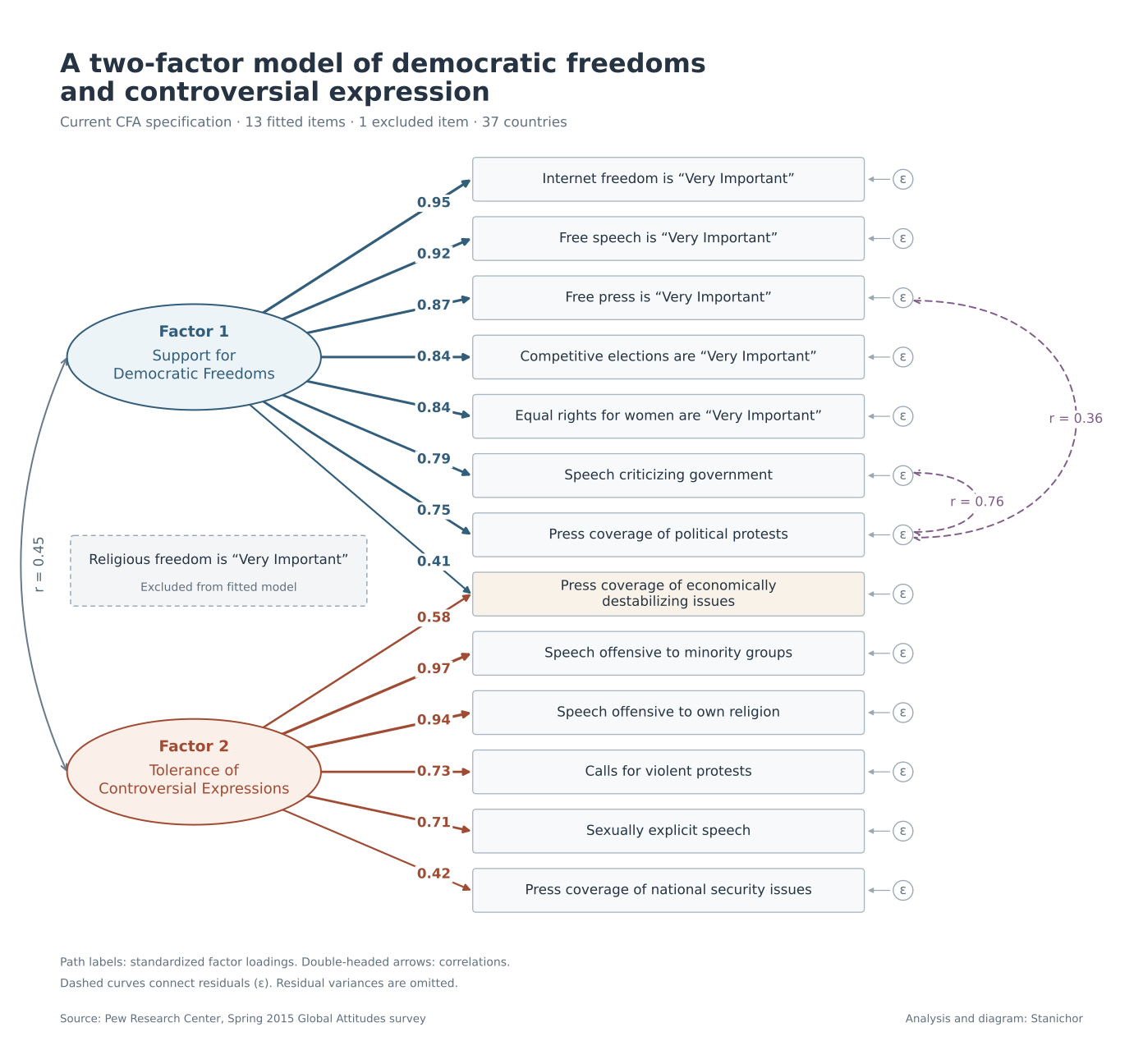
It’s actually a very interesting decomposition. Support for Democratic Freedoms captures support for broad democratic principles (e.g., free speech, a free press, equal rights for women), but Tolerance of Controversial Expressions is arguably the better measure of support for free speech. Rather than asking people to endorse applause lights, it asks whether people are willing to extend the principle to speech they might find offensive, objectionable, or dangerous (e.g., speech offensive to minorities or one’s religion, sexually explicit speech, calls for violent protests). It looks at cases where there’s a tradeoff to be made, rather than cases where everybody knows that the principle is Good.
When we plot each country’s scores on the two factors, some interesting patterns emerge.
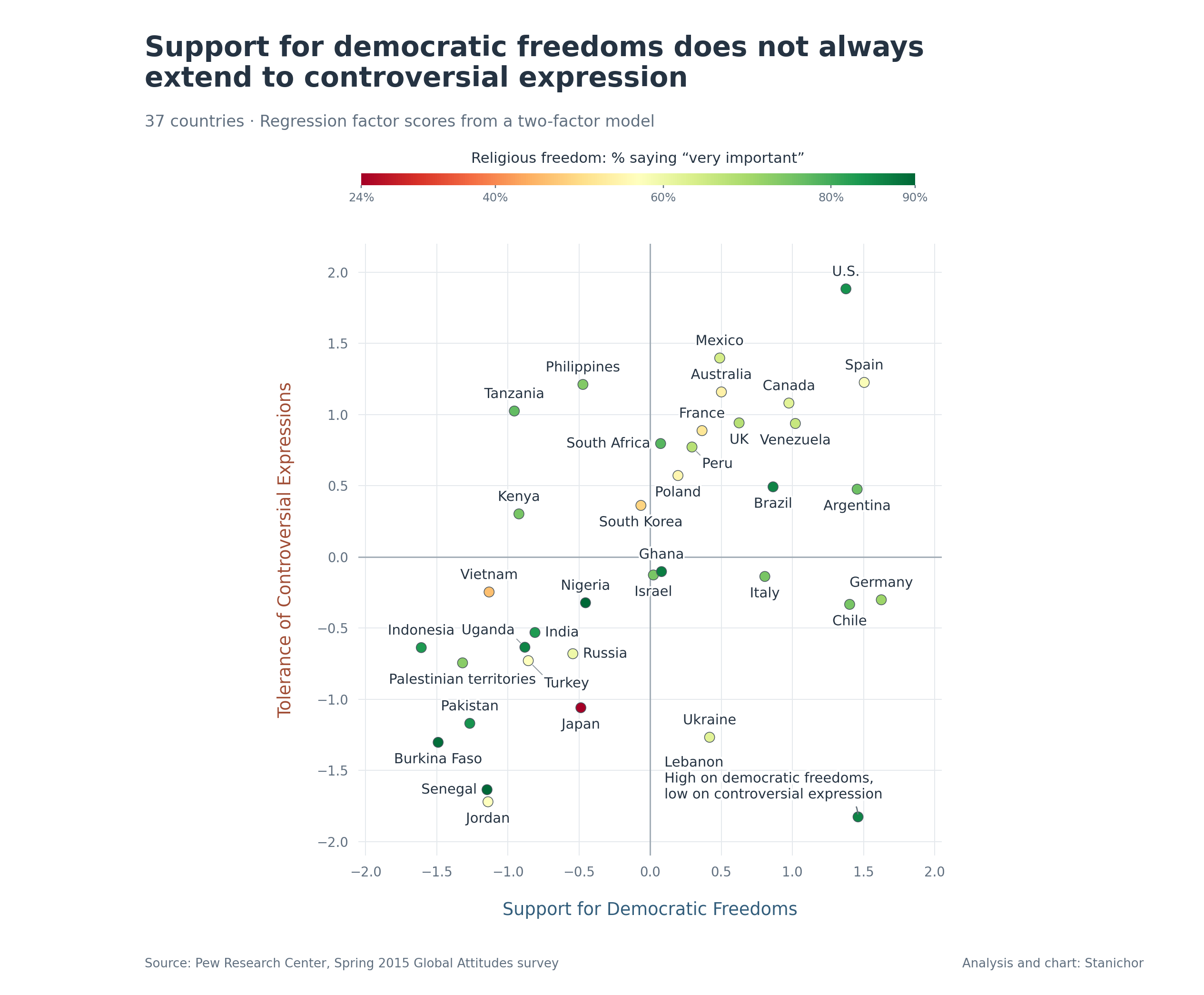
While the United States scores near the top on Support for Democratic Freedoms (along with Spain, Argentina, Chile, Germany, and Lebanon), it’s the clear leader on Tolerance of Controversial Expressions. For Americans, free speech is more than just a platitude.
We also have an interesting outlier in Lebanon. Despite scoring very highly on Support for Democratic Freedoms, it has the lowest score on Tolerance of Controversial Expressions. And this in a country where 86% of respondents consider religious freedom very important. What gives? A clue lies in the specific items on which Lebanon scores particularly low:
- Speech offensive to minority groups: 1% support
- Speech offensive to one’s religion or beliefs: 1% support
- Calls for violent protests: 6% support
Fun fact: Did you know that the last time Lebanon conducted a census was in 1932? There hasn’t been another census since, very much on purpose. The results of that census formed the basis of a system in which political power is distributed among religious communities. That system persists to this day. Under the National Pact of 1943, certain government positions are reserved for members of particular religious communities: the president must be a Maronite Christian, the prime minister a Sunni Muslim, and the speaker of parliament a Shia Muslim.
Lebanon’s civil war ended in 1990 following the signing of the Taif Agreement in 1989, which, among other things, changed the ratio of Christians to Muslims in parliament from 6:5 to 1:1 and weakened the powers of the president.
All of this is to say that religion is a particularly touchy subject in Lebanon. When Pew conducted its survey, the civil war had ended only 25 years earlier, and many of the respondents would have lived through it. Given this history, it’s not hard to see why Lebanese respondents might support free speech in the abstract while objecting to forms of speech they see as threatening the peace between religious communities.
This interpretation gains some plausibility when we look at the other items. While only 1% of Lebanese respondents would allow speech offensive to their religious beliefs, 34% would allow sexually explicit speech (which also loads on Tolerance of Controversial Expressions), and a remarkable 98% would allow people to publicly criticize government policies. The Lebanese are not uniformly intolerant of controversial speech; rather, they’re particularly intolerant of certain kinds of it.
And this is what makes the two-factor solution so informative. Had we summarized all 14 items using a single factor, Lebanon would have looked considerably less remarkable.
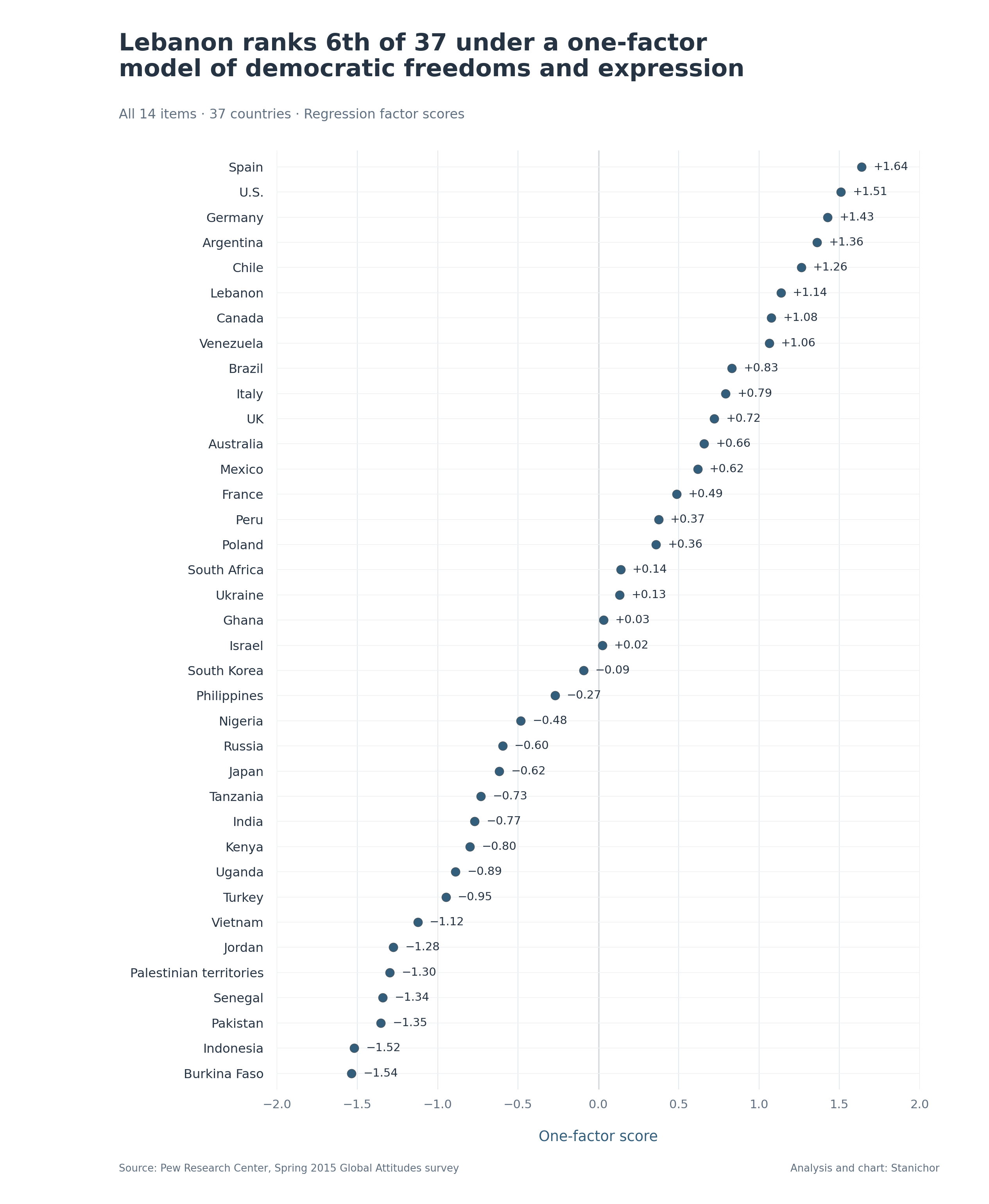
In fact, Lebanon scores quite highly on the single factor. But the single-factor solution obscures much of the variation that the two-factor solution reveals.
Beyond the particular case of Lebanon, the two-factor solution highlights an important point: when investigating how much people support a principle, we shouldn’t just ask whether they endorse it. We should also ask what they’re willing to tolerate in the name of that principle.