EA Is Pretty Left-Wing, Actually
“You called yourself luck,” Akua said, “but that is a lie, Intercessor. You are not a blind roll of the dice. You take sides.”
“I’ve helped both sides of the Game,” the Intercessor dismissed, “I-“
“You help Good,” Akua said. “When you have the choice, that is the truth of you.”
— ErraticErrata, A Practical Guide to Evil (Book 7: Chapter 68: Hallow; Hollow)
Now, the title of this post shouldn’t be a surprise to anyone, but ever since the Trump administration began promoting “Americanism, not Effective Altruism” and thrust EA even further into the political spotlight, I’ve seen EA-aligned people claiming that EA isn’t inherently left-wing or right-wing. I’ll get into the “inherently” part later, but right now, I want to argue that, in practice, EA is pretty obviously left-wing1.
Political Leanings of Effective Altruists
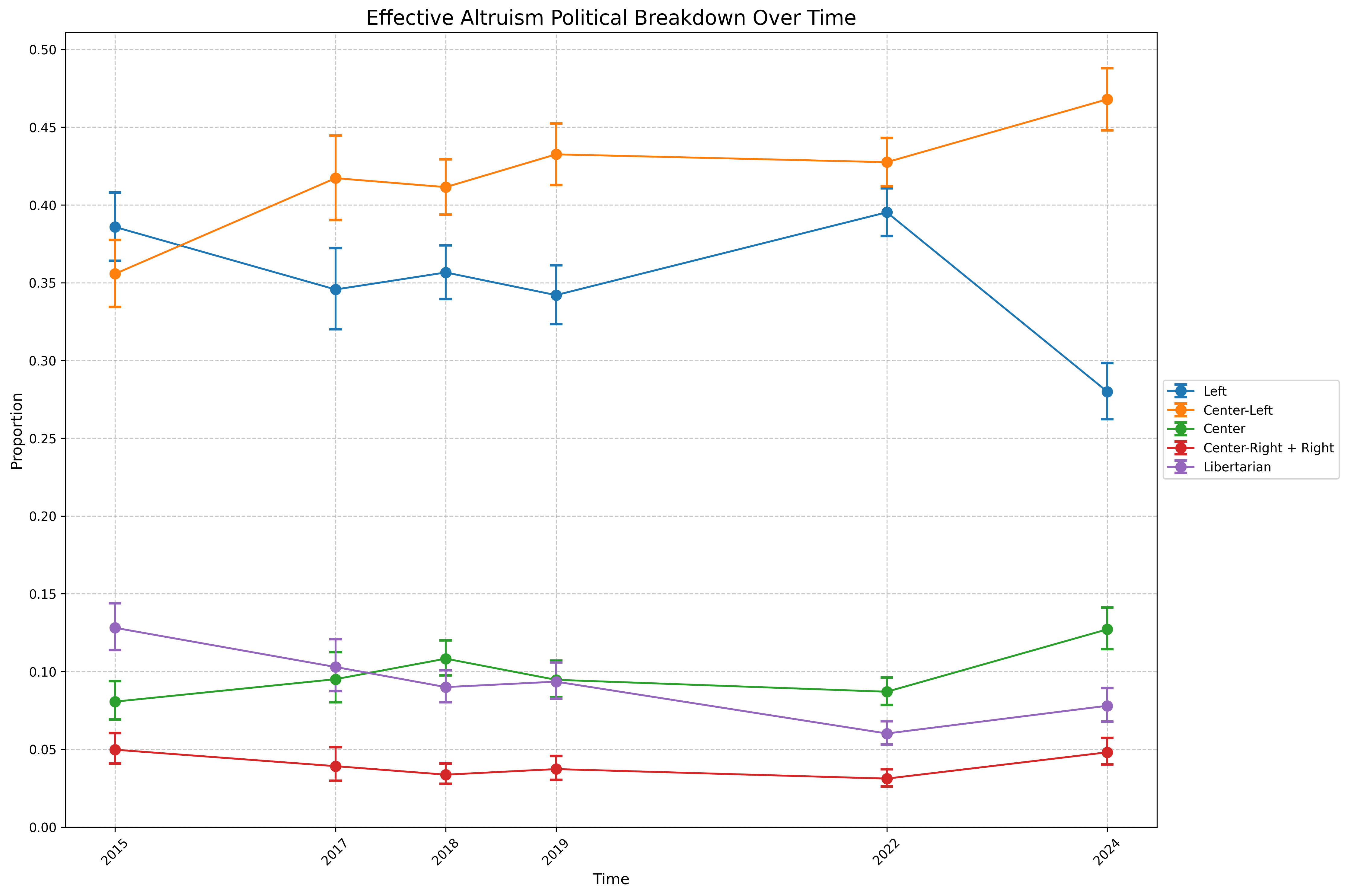
An obvious place to look is the political leanings of effective altruists themselves. Looking at the (semi-)yearly EA Surveys, it has never been the case that more than 5% of effective altruists identify as either right or center-right. Meanwhile, the proportion of effective altruists identifying as left, excluding for the moment center-left, varies between 25% and 40%. Including the center-left brings that figure to between 70% and 85%. So left-leaning effective altruists outnumber right-leaning effective altruists by, at minimum, about 14 to 1. That’s very lopsided2.
Political Leanings of EA Cause Areas
What about the cause areas EA prioritizes? What partisan leanings do those issues have? The major causes EAs seem to care about are AI risk, global poverty and health, biosecurity, and animal welfare. Looking at Rethink Priorities’ Pulse Wave 2, Democrats give higher importance ratings than Republicans to every cause area surveyed, and also show higher support for donating to every cause area. The largest gaps are for climate change, civil rights, global health and development (GHD), and pandemic preparedness3. The gaps are smallest for AI risk, cancer research, and nuclear weapons.
The partisan leaning of AI risk is currently… fluid, so I’ll set it aside for now.
Looking at other sources, a 2025 Pew Research poll shows a 14-point partisan gap on whether the US should provide foreign aid in the form of medicine and medical supplies to developing countries, and a 34-point gap on foreign aid aimed at supporting economic development in developing countries. In a 2018 Pew poll, 32% of Democrats, compared to 12% of Republicans, said “helping improve living standards in developing nations” should be a top foreign-policy priority.
On pandemic preparedness, a 2025 YouGov poll found that 71% of Democrats thought the US needed to do more to prepare for future pandemics, compared to 31% of Republicans. In a 2024 Pew Research poll, 63% of Democrats versus 41% of Republicans said “reducing the spread of infectious diseases” should be a top priority in US long-range foreign policy.
A 2025 Faunalytics survey found that Democrats, on average, rated standard animal-agriculture practices as more unacceptable than Republicans did. A 2023 ASPCA/Ipsos national survey found that Democrats consistently showed higher support for humane-treatment policies.
So, all in all, looking at the partisan skew of major EA cause areas, Democrats consistently show more support for them.
Political Donations and Candidacies
Another way to get at the political leanings of a group is to look at where its political donations end up. Looking at some of the most prominent EA-associated donors:
- In 2020, Dustin Moskovitz and Cari Tuna donated ~\$50 million to Democratic candidates and liberal groups, and \$0 to Republican candidates and conservative groups.
- In 2024, Dustin Moskovitz donated ~\$50 million to Democratic candidates and liberal groups, and \$0 to Republican candidates and conservative groups.
- In 2022, Protect Our Future, an SBF-funded PAC organized around pandemic preparedness, spent \$21 million in independent expenditures, exclusively in Democratic House primaries.
- In 2022, SBF publicly disclosed ~\$37 million in contributions to Democratic candidates and only $320,000 in contributions to Republicans. However, he also later said that he had secretly been the source of approximately \$37 million, and potentially as much as \$80 million, in contributions to Republicans.
What about actual EAs running for office? In 2022, Carrick Flynn, whom The New Yorker described as the first explicitly EA-affiliated congressional candidate, ran as a Democrat.
Admittedly, this evidence is weaker, since I’ve focused on a handful of major donors and the one explicitly EA-affiliated congressional candidate. But, given everything else we’ve seen, it is at least suggestive of the same overall pattern.
Is EA Inherently Left-Wing?
So, all in all, it seems to me that EA is, in practice, very left-leaning. But is it inherently left-wing?
I’m not a fan of theories that try to reduce the two American political sides to a single simple principle4. They seem to overlook the fact that, in the American system, there aren’t two inherent political sides. There are two major parties, for historical and structural reasons, but those parties are better thought of as coalitions of various groups and interests. Additionally, the partisan alignment of particular issues can vary for somewhat contingent reasons5.
So I wouldn’t say EA is inherently anything. But, given the political environment we actually live in, it does seem likely that EA was always going to end up left-leaning. Focusing heavily on the well-being of foreigners and animals is already politically left-leaning in the contemporary US. Pandemic preparedness seems like a more unfortunate case of contingent polarization.
None of this is meant as a criticism of EA. It doesn’t seem to me that EA has been deliberately trying to become overtly partisan. The partisan leanings of its cause areas and of the people who make up the movement are what they are. What, if anything, can be done about that? I don’t know.
But I do think it’s important not to deceive ourselves about the situation, especially as EA is thrust further into the political spotlight. If EA looks overwhelmingly left-leaning from the outside, that matters in an environment where people are increasingly suspicious that institutions associated with the political out-group are really vehicles for the out-group’s interests. Whatever EA does in response, it seems better to start from an accurate picture of how the movement is actually positioned.
-
In this post, I’ll be referring to left and right in the American sense. I’m not well-versed enough in the politics of other countries to make the same claims about them. The United States also seems like the most important country to focus on here, given its outsized role in many of the areas EA cares about. ↩
-
What about the proportion of effective altruists who identify as libertarian? It varies between 5% and 15%, which seems to roughly match the proportion of Americans who identify as libertarian. That said, EA libertarians seem more likely to be “liberaltarians” (socially liberal with free-market preferences) than, say, right-libertarians. ↩
-
This is probably partly downstream of the broader partisan polarization surrounding COVID. ↩
-
For example, during the 2014 Ebola scare, Republicans were more supportive than Democrats of quarantining travelers returning from affected countries. During COVID, however, Democrats were generally more supportive of restrictive public-health measures than Republicans. That said, the policies proposed during Ebola and COVID differed in who they targeted: travelers and foreigners in the former case, ordinary Americans in the latter. ↩